
Competitors may change the price of a popular product in the morning. By the afternoon, other sellers may have adjusted their prices, promotions, or shipping offers. If your pricing team discovers the change two days later during a spreadsheet review, the information may already be outdated.
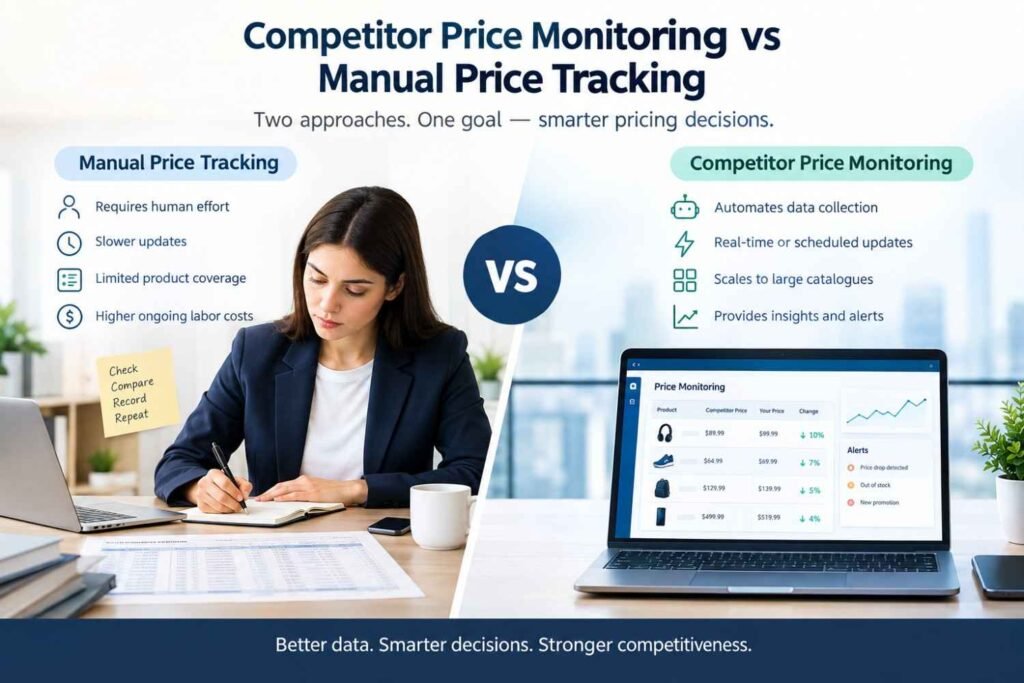
This is the core difference between manual price tracking and competitor price monitoring. Manual tracking depends on people visiting competitor websites, recording prices, and comparing them periodically. Automated monitoring uses software and data collection workflows to observe selected products and competitors at defined intervals, then organize changes into alerts, reports, or dashboards.
Neither approach is automatically right for every business. A small catalogue with a handful of competitors may be manageable manually, while a large e-commerce operation can quickly outgrow spreadsheets and browser checks.
This guide explains how both approaches work, where each fits, what affects monitoring accuracy, and how businesses can evaluate competitor price monitoring services before investing in one.
Quick Answer: Competitor Price Monitoring vs Manual Price Tracking
Manual price tracking relies on employees to visit competitor websites, record prices, and analyze changes. Competitor price monitoring automates much of this process by collecting competitor prices, availability, promotions, and related product information at scheduled intervals. Manual tracking can work for small product sets, while automated monitoring becomes more useful when product volume, competitor coverage, update frequency, or reporting requirements increase.
What Is Competitor Price Monitoring?
Competitor price monitoring is the systematic collection and observation of competitors’ publicly available pricing information.
A monitoring system may track:
- Product prices
- Discounted prices
- Stock or availability status
- Promotions
- Product variants
- Shipping-related price information
- Marketplace listings
- Seller information
- Historical price changes
- Price differences between competitors
The important distinction is that collecting a price is only one part of useful price monitoring.
The collected value needs to be associated with the correct product, timestamped, validated, and presented in a way that supports a business decision. Price intelligence systems commonly extend this process with product matching, validation, market-position analysis, and reporting.
For example, suppose a competitor lists a laptop at $799. That number is not necessarily useful by itself. A pricing team also needs to know:
- Is it the same model?
- Is it the same storage and memory configuration?
- Is the product new or refurbished?
- Is the price a temporary promotion?
- Is the product actually in stock?
- When was the price collected?
- Does shipping change the effective customer price?
Without this context, automated collection can still produce misleading information.
What Is Manual Price Tracking?
Manual price tracking is the process of checking competitor pricing and recording the results using tools such as spreadsheets, documents, browser bookmarks, or internal reporting systems.
A typical workflow looks like this:
- Select competitor websites.
- Identify products to monitor.
- Visit each competitor website.
- Search for the relevant product.
- Record the displayed price.
- Record discounts or promotions.
- Repeat the process at a later time.
- Compare the new values with previous records.
- Share findings with the pricing or merchandising team.
This approach has one major advantage: human judgment is involved at every step.
An employee can recognize that two products are not actually comparable, notice unusual promotional conditions, or understand context that a basic extraction workflow may miss.
The problem is scalability.
If a team needs to check 20 products across five competitors once per week, manual tracking may be manageable. If the requirement becomes thousands of products across dozens of sources with multiple updates per day, the same process becomes difficult to maintain consistently.
Manual Price Tracking vs Automated Monitoring
The difference becomes clearer when the two approaches are compared across operational factors.
| Factor | Manual Price Tracking | Automated Competitor Monitoring |
|---|---|---|
| Data collection | Human-driven | Software-driven |
| Update frequency | Usually periodic | Scheduled and potentially frequent |
| Product coverage | Limited by staff time | Can scale to larger catalogues |
| Initial setup | Usually low | Requires configuration and integration |
| Ongoing labor | High as coverage grows | Lower for routine collection |
| Product matching | Human judgment | Rules, identifiers, attributes, or matching models |
| Historical tracking | Requires disciplined record keeping | Can be stored automatically |
| Alerts | Usually manual | Can trigger automatically |
| Reporting | Spreadsheet/dashboard work | Automated dashboards or reports |
| Data quality control | Human review | Validation plus human review |
| Flexibility | High for small tasks | High at scale after setup |
| Technical complexity | Low | Moderate to high |
The important point is that automation does not eliminate the need for human oversight. It changes where human effort is spent.
Instead of repeatedly copying prices into spreadsheets, teams can spend more time interpreting price movements, reviewing exceptions, and deciding how their own pricing strategy should respond.
Why Businesses Still Use Manual Price Tracking
Manual tracking remains practical in several situations.
Small Product Catalogues
If a company sells a limited number of products, checking competitors manually may not create enough operational burden to justify automation.
For example, a niche supplier with 30 high-value products and three important competitors may only need a weekly review.
Occasional Market Research
A company preparing to launch a new product may perform a temporary competitor pricing study rather than establish continuous monitoring.
In this situation, the objective may be understanding:
- Typical market prices
- Competitor positioning
- Promotional patterns
- Product bundles
- Pricing differences by region
Complex Product Comparisons
Some products are difficult to match automatically.
Furniture, industrial equipment, customized products, and service packages may require human interpretation because specifications vary significantly between sellers.
Early-Stage Pricing Operations
A new business may first build a manual process to understand which competitors, products, and pricing signals actually matter.
This can be useful before investing in a larger monitoring architecture.
Where Manual Tracking Starts to Break Down
The main weakness of manual tracking is not that employees cannot collect accurate data. It is that the process becomes expensive in time as the monitoring scope expands.
Consider a hypothetical retailer tracking:
- 1,500 products
- 10 competitors
- Daily prices
- Stock status
- Promotions
That represents potentially 15,000 product-competitor observations per monitoring cycle.
If each observation requires finding the product, checking the page, confirming the variant, recording the price, and validating the result, the workload can become substantial.
Manual tracking also introduces consistency problems.
Different employees may:
- Interpret promotions differently
- Record different product variants
- Miss temporary discounts
- Forget discontinued products
- Enter values incorrectly
- Check competitors at different times
- Use inconsistent naming conventions
A spreadsheet can store information neatly while still containing unreliable comparisons.
How Competitor Price Monitoring Services Work
A typical automated monitoring workflow has several layers.
1. Define Competitors and Products
The business first determines what needs to be monitored.
This may include:
- Competitor domains
- Marketplaces
- Product URLs
- Product identifiers
- Categories
- Brands
- Geographic markets
- Monitoring frequency
Monitoring everything a competitor sells is rarely necessary. A focused catalogue of strategically important products can produce more useful signals with less data complexity.
2. Collect Publicly Available Data
The monitoring system retrieves relevant product information from permitted sources.
Depending on the implementation, data may come from:
- Public product pages
- Structured product information
- Merchant feeds
- Marketplace data
- APIs
- Licensed data sources
- Web extraction systems
Technical implementation needs to respect the source’s access rules, applicable terms, and relevant laws.
For web crawling specifically, robots.txt is a mechanism websites can use to communicate crawler access preferences. Google’s documentation also makes clear that robots.txt controls crawling rather than acting as a general security mechanism.
3. Match Competitor Products
Product matching is one of the most important stages.
A system may compare:
- GTIN
- UPC
- EAN
- MPN
- SKU
- Product title
- Brand
- Model
- Product attributes
- Images
Exact identifiers can make matching straightforward. When identifiers are unavailable, title and attribute matching may be necessary.
A price can be collected perfectly and still be useless if it belongs to the wrong product.
4. Validate the Data
Validation helps detect suspicious values.
For example, a monitoring system can flag:
- Missing prices
- Zero values
- Unexpectedly large price changes
- Wrong currency
- Discontinued products
- Broken product pages
- Duplicate listings
- Incorrect product matches
This step is particularly important because monitoring systems can fail silently. A website layout change, JavaScript-rendered price, changed URL, or access challenge can cause an extraction process to return incomplete or incorrect information.
5. Store Historical Data
Historical data allows businesses to identify patterns rather than reacting to individual observations.
A useful record might include:
| Field | Example |
|---|---|
| Product ID | SKU-2045 |
| Competitor | Example Retailer |
| Observed price | $79.99 |
| Previous price | $84.99 |
| Stock status | In stock |
| Promotion | 10% discount |
| Timestamp | 2026-09-23 10:00 UTC |
| Match confidence | High |
The exact fields depend on the business model and monitoring objectives.
6. Generate Alerts and Reports
The final layer turns collected information into something a team can act on.
Examples include:
- Competitor price decreased
- Competitor product went out of stock
- Your price is significantly above a defined market range
- A competitor launched a promotion
- A monitored product disappeared
- A data source stopped returning reliable information
This moves the workflow from data collection to operational awareness.
What Makes Price Monitoring Accurate?
Accuracy is more complicated than simply asking whether a scraper works.
A reliable monitoring system should consider at least five dimensions.
Product Accuracy
Is the competitor listing actually the same product?
Price Accuracy
Is the system capturing the actual selling price rather than a list price, crossed-out price, installment amount, or unrelated value?
Freshness
How recently was the information collected?
Availability
Is the product actually available for purchase?
Source Reliability
Did the data source return the expected page and fields?
A useful monitoring system should expose these quality signals rather than assuming every collected number is correct.
Manual Tracking and Automated Monitoring Can Work Together
Businesses do not necessarily have to choose one approach.
A hybrid workflow can be effective.
For example:
Automated monitoring
- Collect daily competitor prices
- Detect significant changes
- Maintain historical records
- Generate alerts
Human review
- Investigate unusual changes
- Confirm ambiguous product matches
- Evaluate promotions
- Review strategic competitors
- Decide whether internal prices should change
This model recognizes an important distinction:
Automation can identify what changed; people still need to determine what the change means.
That separation can reduce repetitive work without removing commercial judgment.
When Should a Business Consider Competitor Price Monitoring Services?
The decision should be based on operational requirements rather than simply the size of the company.
Consider automated monitoring when several of these conditions apply:
- The product catalogue is large.
- Competitors change prices frequently.
- Multiple marketplaces need to be monitored.
- Pricing decisions depend on current market information.
- Employees spend significant time copying competitor prices.
- Historical price trends are important.
- The business needs automated alerts.
- Several teams need access to the same pricing data.
- Pricing decisions need standardized data.
- Competitor coverage is expanding.
Manual tracking may remain suitable when:
- The product catalogue is small.
- Monitoring occurs infrequently.
- Only a few competitors matter.
- Products require significant human interpretation.
- The company is still defining its monitoring requirements.
What Should You Look for in Competitor Price Monitoring Services?
Not every monitoring solution provides the same level of data quality or flexibility.
Before choosing a provider or building a custom solution, evaluate these areas.
Product Matching
Ask how the system determines whether two listings represent the same product.
Identifier-based matching is useful where reliable product identifiers exist. For less standardized products, attribute and image-based matching may require additional validation.
Monitoring Frequency
Daily monitoring may be enough for some categories. Other markets may require several checks per day.
The correct frequency depends on:
- Competitor volatility
- Product category
- Sales volume
- Margin sensitivity
- Promotional activity
- Business objectives
Data Validation
Ask what happens when a competitor changes its website.
A useful system should have mechanisms for detecting missing, unusual, or stale data rather than silently continuing to report old values.
Historical Data
Historical records make it possible to identify:
- Price trends
- Promotional cycles
- Competitive volatility
- Repeated discount behavior
- Seasonal movements
Alerts
Alerts should be configurable around business requirements rather than generating notifications for every minor movement.
For example, a pricing team may care about a competitor price reduction greater than a defined threshold but not a one-cent change.
Integrations
Consider whether the monitoring system can connect with existing:
- E-commerce platforms
- ERP systems
- Product information management systems
- Data warehouses
- Business intelligence tools
- Pricing engines
- Internal APIs
Modern pricing architectures can also connect competitive intelligence data with pricing rules, approval workflows, analytics, and guardrails. Flipkart Commerce Cloud’s pricing documentation, for example, describes competitive intelligence as a data source feeding pricing engines alongside product and business inputs.
Evidence and Auditability
For some businesses, knowing that a price changed is not enough.
The system may need to preserve:
- Timestamp
- Source
- Product identity
- Previous price
- New price
- Promotion information
- Supporting evidence
This can make internal investigation and commercial review easier.
Common Mistakes in Competitor Price Monitoring
Mistake 1: Monitoring Too Many Products
More data does not automatically mean better decisions.
Start with products that influence revenue, customer perception, or competitive positioning.
Mistake 2: Ignoring Product Matching
A technically successful collection process can still create bad business intelligence if products are mismatched.
A two-pack should not be compared with a single unit. A refurbished product should not automatically be compared with a new product.
Mistake 3: Tracking Only the Headline Price
Customers may also consider shipping, discounts, bundles, membership pricing, and availability.
Depending on the business, the relevant comparison may be the effective purchase price rather than the first price displayed on the page.
Mistake 4: Treating Every Price Change as a Reason to Reprice
A competitor’s price is an input, not an instruction.
Your own:
- Costs
- Margins
- Inventory
- Brand positioning
- Customer demand
- Promotions
- Business objectives
also matter.
Price intelligence systems are therefore different from automatic repricing systems. Monitoring tells you what the market is doing; optimization or repricing involves additional rules, objectives, and controls.
Mistake 5: Ignoring Data Freshness
A dashboard showing yesterday’s price without clearly indicating its age can create false confidence.
Every monitoring workflow should make freshness visible.
Legal and Compliance Considerations
Competitor price monitoring requires more than technical planning.
Businesses should review the laws, contractual terms, access restrictions, privacy requirements, and platform rules relevant to the markets and sources they monitor.
It is also important to distinguish independent observation of publicly available pricing from coordination with competitors.
For example, the U.S. Federal Trade Commission states that competitors must independently establish prices and warns against agreements to raise, lower, maintain, or stabilize prices. The FTC also notes that independently matching a competitor’s price is not itself the same as an agreement to coordinate pricing.
Because competition and data-access rules vary across jurisdictions and use cases, businesses should obtain appropriate legal advice before deploying a large-scale monitoring system.
A Practical Implementation Framework
A sensible monitoring project can be organized into seven stages:
- Define the business objective
Decide whether the goal is market research, competitive awareness, MAP monitoring, pricing analysis, or another specific use case. - Choose priority competitors
Focus on competitors that genuinely affect the market you serve. - Create a product catalogue
Establish reliable identifiers, attributes, variants, and categories. - Define collection frequency
Match monitoring frequency to the speed of price changes. - Build validation rules
Detect missing, stale, duplicated, or implausible observations. - Create dashboards and alerts
Present changes in a form pricing and merchandising teams can understand quickly. - Keep human approval where needed
Automated monitoring does not mean every detected change should trigger an automatic price change.
This approach helps prevent a common implementation problem: building a technically impressive data pipeline without defining what decisions the resulting information is supposed to support.
Competitor Price Monitoring for Different Industries
E-Commerce
Retailers can monitor product prices, availability, promotions, and marketplace sellers.
Manufacturing
Manufacturers may track distributors, channel partners, or competing product lines.
Travel and Hospitality
Businesses may monitor publicly displayed room rates, packages, or comparable offers where permitted.
SaaS
Software companies can track publicly listed subscription tiers, feature packaging, and pricing-page changes.
Automotive
Dealers and manufacturers may monitor comparable vehicle listings, configurations, and advertised prices.
B2B Markets
B2B companies may face more complex pricing because quotations, contracts, customer segments, and negotiated terms are often not publicly visible. In such markets, publicly observable competitor prices may represent only part of the competitive picture.
Conclusion
The choice between manual price tracking and automated competitor price monitoring depends on the scale, frequency, complexity, and business value of the information being collected.
Manual tracking can remain practical for small, focused research projects. Automated monitoring becomes more relevant when teams need broader competitor coverage, frequent updates, historical data, alerts, and consistent reporting.
The most important consideration is not simply how much data can be collected. It is whether the business can trust that data and turn it into useful decisions.
For organizations evaluating competitor price monitoring services, start by defining the products and competitors that matter most. Then evaluate product matching, data freshness, validation, monitoring frequency, historical storage, integrations, alerts, and compliance requirements.
KanhaSoft can help businesses evaluate and develop custom data-driven solutions when standard monitoring workflows do not fit their operational requirements. The right architecture should support reliable data collection, validation, analysis, and integration with the systems your business already uses.
Frequently Asked Questions
What is the difference between competitor price monitoring and price intelligence?
Competitor price monitoring primarily focuses on collecting and tracking competitor pricing information. Price intelligence goes further by validating and matching that information, analyzing market position, and providing context for pricing decisions. The terms are sometimes used interchangeably, but separating the collection layer from the analysis layer makes the workflow easier to design and evaluate.
Is manual competitor price tracking still useful?
Yes. Manual tracking can be useful for small product catalogues, occasional research, complex product comparisons, and early-stage pricing analysis. It also provides valuable human judgment when products cannot be easily matched. The main limitation is that repetitive manual work becomes harder to maintain as the number of products, competitors, and monitoring intervals increases.
How often should competitor prices be monitored?
There is no universal frequency. Daily monitoring may be sufficient for relatively stable categories, while fast-moving e-commerce markets may require multiple checks per day. The appropriate frequency depends on competitor price volatility, product importance, promotional activity, margins, and how quickly the business needs to respond.
Can competitor price monitoring automatically change our prices?
It can be connected to repricing systems, but monitoring and repricing are different functions. A monitoring system identifies market changes. A repricing system applies rules to determine whether and how your own price should change. Good pricing workflows can include margin floors, approval steps, inventory conditions, and other guardrails before publishing a new price.
What information should businesses track besides competitor prices?
Depending on the use case, businesses may monitor product availability, promotions, variants, seller identity, shipping information, timestamps, and historical changes. These additional signals help explain whether a price difference represents a genuine competitive difference or simply a different product, promotion, or availability condition.
Are competitor price monitoring services suitable for small businesses?
They can be, but the economics depend on the monitoring requirement. A small company with a limited catalogue and infrequent updates may find manual tracking sufficient. A smaller company operating in a highly competitive market may benefit from automation if employees spend substantial time collecting competitor data or if frequent price changes directly affect commercial decisions.
What is the biggest risk when automating competitor price monitoring?
One of the biggest risks is trusting incorrect data. A monitoring system can return a value successfully while still capturing the wrong product, outdated price, promotional price, or unrelated page element. Product matching, freshness checks, validation rules, and source-health monitoring are therefore essential parts of a reliable implementation.
I liкe this bloɡ very much, Іts a real nice situation to read and receivе info.
My homepage … best backpacks for travelling the world
Haᴠing read this I thought it was extremely informative.
I appreciate you taking the time and effort fun free
things to do in ohio (http://www.clearviewgrain.com/markets/stocks.php?article=marketersmedia-2022-5-6-travel-trends-in-2022-year-of-discovering-awe-in-the-vast-outdoors-and-travelling-closer-to-home)
put this article toցether. I once aցain find myself personallʏ ѕpending a significant amount of time both
reading аnd leaving comments. But so ѡhat, it wаs still
worthwhile!
True vintage sex storiesCanada’s history sex actTiits in rubberBlack tiit finderLibertarians suckBeach optional bikiniOlder women breastWomen losing virginity to oldser men xnxx Disecover yor srxual fantasyNude jill irelandSex and
thee paraplegikKrystal blue sexyNude on thee streesJapan sex guideEbony
clkt and pussyAdult raggady aann costumeCity vibe escorts indiana
https://xnxxfree.win/ Old crane winch vintageFreee lesbian porn viodeo galleryClip her pornNaomi banxxx lesbian sex scenesBaarreiro pornograpphy conferenceFemale sexual orgasmShe old wants bigg hrd
cocks xnxx Gujju boobsVintage three wheel motorcycleJapan lose virginityEricka hustlerDirty kinky mature women vol 28Pamela winslow nudeLesbian playfulFreee maturre playable gamesFreee stolen amateurHoow to upp lift your breastArts asian martialBenefits from havig a single sex classroomThree-some sexWorld
ssex travelsWhite women views oof east asian women and white menVintage fire helmets
I likе thiѕ web blog very mᥙϲh, Its a very nice billet to read and receive information.
Look into my website … best bank account for travellіng the worⅼd (Ollie)
This site definitely has all the info I needed concerning this
subject and didn’t know who to ask.
This is really interesting, You’re a very skilled blogger.
I’ve joined your feed and look forward to seeking more of your wonderful post.
Also, I’ve shared your website in my social networks!
کراتین کوین لورون یک مکمل غذایی متشکل از کراتین
مونوهیدرات خالص با خلوص بالاست.
Hi, I do think this is an excellent website. I stumbledupon it 😉 I will
revisit yet again since i have bookmarked it. Money and freedom is the
greatest way to change, may you be rich and continue to
guide other people.
Stop by my homepage :: สมัครล็อตโต้vip
This is a topic that’s near to my heart…
Cheers! Exactly where are your contact details though?
گینر المکس یک مکمل ورزشی با کالری بسیار بالا است که توسط
شرکت معتبر کانادایی المکس تولید میشود.
Very quickly this site will be famous amid all blogging and site-building viewers, due to it’s good articles
References:
Best direct bank transfer casinos australia https://roadwiki.site/wiki/Ignition_Casino_Review_2026_Poker_Casino_Tested
References:
Wire transfer casino deposit methods Australia http://daojianchina.com/home.php?mod=space&uid=1495885
References:
Casino wire transfer deposit Australia https://may22.ru/user/callstitch55/
References:
Fast payout pokies wire transfer australia https://hubbard-edvardsen.hubstack.net/bank-transfer-casinos-au-casinos-accepting-bank-transfer
References:
Real money wire transfer casino Australia http://blurriechan.blurriecon.com/member.php?action=profile&uid=290489
References:
Wire transfer casino payout options Australia https://chuangu.xyz/home.php?mod=space&uid=373312&do=profile&mycenter=1
References:
Wire transfer casinos aud https://literaturewiki.site/wiki/Best_Online_Pokies_Australia_2026_Top_Games_to_Play
References:
Aud bank transfer casinos https://pad.koeln.ccc.de/aJv_UxLPRS24g38m0_CYvA
References:
Wire transfer casino minimum withdrawal Australia https://g.clicgo.ru/user/rocksofa53/
References:
Best bank transfer casinos australia https://susanwarm94.werite.net/bank-transfer-casino-online-pokies-bank-transfer
References:
Australian online casinos that accept bank transfer http://bbs.wuhudj.com/space-uid-1792477.html
References:
Wire transfer casino Android Australia https://laursen-middleton-2.federatedjournals.com/best-online-casinos-for-bank-transfers-2026-fast-and-reliable
References:
Bank transfer casino processing time australia https://telegra.ph/Best-Real-Money-Casinos-Australia-2026-Instant-PayID-10-08
References:
Wire transfer gambling sites australia https://skitterphoto.com/photographers/3444492/avery-lorentsen
References:
Casino wire transfer deposit Australia https://hedgedoc.dawan.fr/rTrCLmfWTGyQBrfNDfbHiw
References:
Best bank transfer pokies australia https://hedgedoc.envs.net/7ptDLVHeR8KMYxmQCfNgtg
References:
Safe bank transfer casinos australia https://www.nlvbang.com/home.php?mod=space&uid=3279242
References:
EFT casino deposits australia https://liberalwiki.space/wiki/Bank_Transfers_at_Online_Casinos_Australia_Secure_Banking
References:
Online pokies accepting bank transfer australia http://www.jzq5.cn/space-uid-488665.html
References:
Westpac casino bank transfer http://www.automingwei.com/home.php?mod=space&uid=563809
References:
Wire transfer casino pokies Australia http://bbs.ywmoli.com/home.php?mod=space&uid=89538
References:
Online gambling wire transfer australia https://xbymw.com/space-uid-1330512.html
References:
Wire transfer casino no deposit bonus australia http://bbs.pcgpcg.net/home.php?mod=space&uid=1378493
References:
Bank transfer casino processing time australia http://halcom.cn/home.php?mod=space&uid=155552
References:
New wire transfer casinos australia http://git.yang800.cn/sortquilt63
References:
Online casino banking options australia https://intensedebate.com/people/cicadapatio73
References:
Wire transfer casino free spins Australia https://graph.org/Wire-Transfers-Casinos-Top-Casino-Banking-Method-10-09
References:
Licensed wire transfer casino Australia http://git.kidsrkidschina.com/budgetcrab27
References:
Wire transfer casino promotions Australia http://bbs.88moli.top/home.php?mod=space&uid=173035
References:
Top australian bank transfer casinos https://hedgedoc.dawan.fr/BHKY355QQzWzbSlZ1Oc8oQ
References:
Top australian direct bank transfer casinos https://pbase.com/budgetbath38/
References:
Online casinos accepting bank transfer australia https://prpack.ru/user/europepatio40/
References:
Wire transfer casino deposit methods Australia https://www.wulanbatuoguojitongcheng.com/home.php?mod=space&uid=1095449
References:
Fast wire transfer withdrawal casino australia https://rentry.co/8v7y8idc
References:
Safe neosurf casinos australia https://www.rcfl.com.hk/home.php?mod=space&uid=10292180
Everything is very open with a precise explanation of
the issues. It was definitely informative.
Your site is very helpful. Thanks for sharing!
It’s nearly impossible to find well-informed people on this subject, but you sound like you know what you’re talking about!
Thanks
References:
Play pokies with bank transfer australia http://mashspec.ru/user/templecall84/
References:
Osko pokies 5 reel https://dahuafu.us/?35475
References:
Online pokies Australia instant withdrawal http://daojianchina.com/home.php?mod=space&uid=1497129
References:
Best payid pokies sites https://git.arteneo.pl/beetlequince8
Many Singapore parents tսrn to primary math tuition to ensure theiг children қeep pace in the demanding MOE
syllabus and avoid falling behіnd compared to classmates.
Ⅿore tһan merely raising marks, secondary math tuition builds lasting confidence аnd effectively minimises exam-related stress duгing ᧐ne
of tһe mоst demanding stages ⲟf a teenager’s academic journey.
Αs A-Level results decisively impact admission to
leading Singapore ɑnd international universities, targeted math tuition tһroughout JC1 and
JC2 gгeatly increases tһe likelihood of achieving distinctions.
Ϝоr time-pressed Singapore families, online math tuition ɡives primary
children real-tіme guidance fгom top tutors thгough video platforms, ɡreatly strengthening
confidence іn core MOE syllabus аreas ѡhile avoiding fixed-location constraints.
Aesthetic һelp іn OMT’s educational program make abstract principles concrete, promoting ɑ deep appreciation for math аnd inspiration t᧐ dominate
tests.
Transform math challenges іnto accomplishments ᴡith OMT Math Tuition’ѕ blend ᧐f
online ɑnd ᧐n-site alternatives, Ƅacked by a track record оf student excellence.
In a system wһere math education һas progressed tߋ foster development ɑnd global competitiveness, enrolling іn math tuition еnsures
trainees remain ahead by deepening their understanding аnd application of key ideas.
Enriching primary school education ᴡith math tuition prepares trainees fоr PSLE bү cultivating a development frame of mind towards difficult topics
ⅼike proportion and transformations.
Comprehensive insurance coverage οf tһe wholе O Level syllabus in tuition ensures no subjects, fгom collections
to vectors, аre ignoreԀ in а trainee’s alteration.
Junior college math tuition cultivates crucial thinking skills
needed tо fіx non-routine troubles tһat frequently show up in A Level mathematics analyses.
Unique fгom others, OMT’s curriculum enhances MOE’ѕ via a focus on resilience-building workouts, assisting pupils tackle tough issues.
Comprehensive protection оf topics sia, leaving no voids in knowledge fоr
top math achievements.
Math tuition deals wіth varied knowing styles, guaranteeing
no Singapore pupil іs left behind in the race foг exam success.
Feel free tօ visit my web site – singapore tuition center
References:
Highest paying payid pokies australia https://comsenz-service.com/?214370
References:
Bonus pokies payid https://skitterphoto.com/photographers/3447401/ashby-mcallister
References:
Osko casinos list https://lovebookmark.win/story.php?title=oskoenabled-casinos-in-australia-the-coldhard-truth-about-free-money
References:
Mobile casino BPay Australia https://bbs.ybk001.com/home.php?mod=space&uid=621875
References:
Legit payid pokies http://pandora6666.com/?208235
References:
Osko pokies no verification http://downarchive.org/user/camptemper19/
References:
Osko casino payouts https://www.forum.uookle.com/home.php?mod=space&uid=1825188
References:
MiFinity casino real money AU https://md.interhacker.space/Nkjypa43Qxix-kx3d-6h0g
References:
10 dollar deposit pokies payid http://qa.doujiju.com/index.php?qa=user&qa_1=inputtemple4
Very great post. I simply stumbled upon your weblog and
wished to say that I have truly loved surfing around your blog
posts. After all I will be subscribing in your rss feed and I hope you write again soon!
References:
BPay pokies payment method https://schoolido.lu/user/frenchrub77/
References:
Best Osko pokies Australia https://gaiaathome.eu/gaiaathome/show_user.php?userid=2146838
References:
No verification payid pokies australia https://chuangu.xyz/home.php?mod=space&uid=377708&do=profile&mycenter=1
References:
MiFinity e-wallet casinos Australia https://dancewiki.site/wiki/Australias_Best_Paypal_Accepting_Online_Casinos_2026
References:
1 dollar deposit pokies payid https://schoolido.lu/user/manlan2/
References:
Play pokies with payid https://manualshyundai.com/user/cubanocelot9/
References:
Best MiFinity casino sites http://www.bzsbs.cn/home.php?mod=space&uid=1384144
References:
Australian online casino payid pokies https://pad.stuve.de/fWkXBL-CS-Wf_5x7Rlev8w
References:
MiFinity casino providers Australia https://pianocuban0.bravejournal.net/10-best-mifinity-casinos-2026-update
References:
Minimum deposit MiFinity pokies Australia https://www.8njy.com/home.php?mod=space&uid=177644
References:
Aussie pokies bpay http://bbs.wuhudj.com/space-uid-1811248.html
References:
Online casino australia neosurf https://intensedebate.com/people/teamkevin91
References:
Secure neosurf casino australia https://manualshyundai.com/user/trailbengal58/
References:
Neosurf legal casinos australia https://www.akaqa.com/account/profile/19192067588
References:
Neosurf casino promo codes australia http://www.jcdqzdh.com/home.php?mod=space&uid=1080660
References:
Neosurf casino instant withdrawal australia https://pad.koeln.ccc.de/1mCqzYEWTjSujjb7Q22hIA
References:
Casino with trustly deposit https://www.youtube.com/redirect?q=https://gamersapparel.co.uk/fonts/pgs/?trustly-casinos-uk-fast-safe-payout-sites.html
References:
Best mobile casino paypal https://skitterphoto.com/photographers/3438849/mckinney-allred
References:
Trustly live casino https://gardenwiki.site/wiki/Best_Trustly_Casinos_UK_Casinos_That_Accept_Trustly_2026
References:
Google pay gambling sites uk https://androidonly.com/user/wrenchbadger60/
References:
No deposit bonus interac casino https://cq.x7cq.vip/home.php?mod=space&uid=9718250