
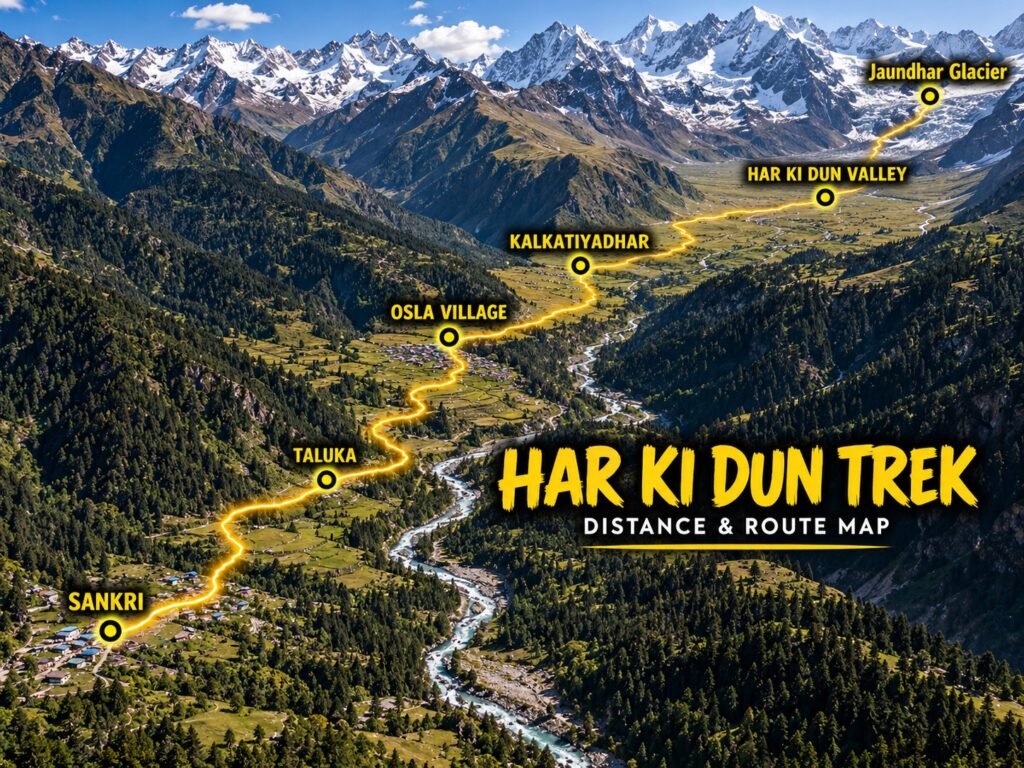
Har Ki Dun Trek 2026 – 7 Days from Dehradun (Itinerary, Cost & Route)
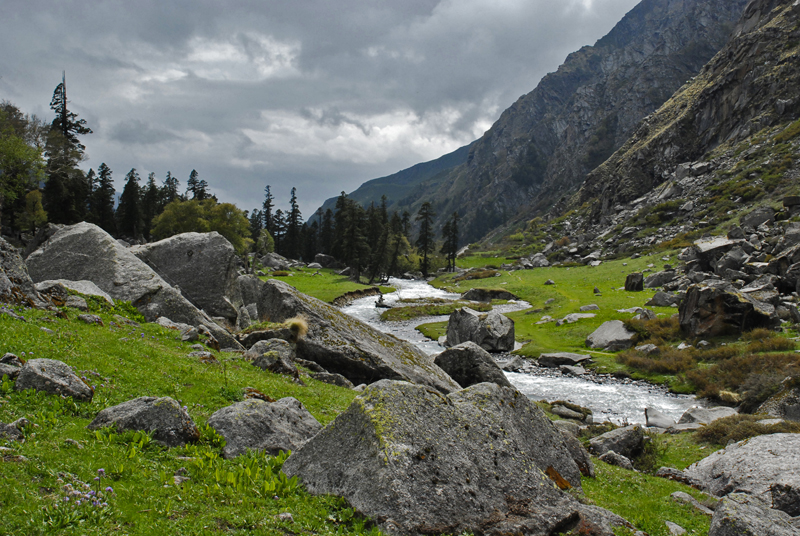
Har Ki Dun is a 6-night, 7-day valley trek in Govind Pashu Vihar National Park, Uttarkashi district, Uttarakhand. You drive from Dehradun to Sankri, walk about 44–46 km return from Taluka to a high valley at roughly 3,500 m (about 11,700 ft), and look straight at the Swargarohini range. It is graded moderate: no technical climbing, but long days and a real altitude gain. The best windows are March–June and September–November. A group departure from Dehradun typically costs ₹10,999 per person;
Har Ki Dun Trek at a Glance
| Detail | Information |
|---|---|
| Region | Govind Pashu Vihar National Park, Uttarkashi, Garhwal Himalayas |
| Duration | 7 days / 6 nights from Dehradun |
| Base village | Sankri (about 1,900 m) |
| Trek start | Taluka, 12 km by road from Sankri |
| Walking distance | About 44–46 km round trip |
| Highest point | Har Ki Dun valley, about 3,500–3,566 m (11,500–11,700 ft) |
| Difficulty | Moderate |
| Technical climbing | None |
| Best months | March–June, September–November |
| Optional side trips | Marinda Tal, Jaundhar Glacier viewpoint |
| Group price | ₹10,999 per adult from Dehradun |
Why people choose Har Ki Dun
Most Himalayan treks reward you with one summit view. Har Ki Dun is different: it is a long walk into a landscape. You start among terraced fields and wooden houses, pass through one of the oldest inhabited villages in the region, move through deodar and maple forest, and finish in an open glacial valley with Swargarohini and its neighbouring peaks closing off the horizon.
The valley’s name is usually read as “Valley of the Gods” (Har referring to Shiva, Dun meaning valley). Local belief links the region to the Pandavas’ final journey, and the village of Osla keeps a temple to Duryodhana, which is unusual in India and one reason this walk has a cultural side that few other beginner treks offer.
The route, stage by stage
The trail follows the Supin river upstream on a single, easy-to-follow path. There are no junctions where you can lose your way in normal conditions.
- Dehradun → Sankri (road). About 200 km via Mussoorie, Purola and Mori. Plan 8–10 hours.
- Sankri → Taluka (road), then Taluka → Seema (walk). The first day on foot is about 12 km along the river, with forest, small waterfalls and your first village sections.
- Seema → Osla → Har Ki Dun. The big day. The trail passes Osla, climbs through forest and ridge sections and opens into the valley. This is where most of the elevation is gained.
- Valley day. Rest, acclimatise and, if conditions allow, walk toward Marinda Tal or the glacier viewpoint.
- Return along the same trail to Seema, then Taluka and Sankri.
Because you come back the same way, the return legs feel quicker and lighter, but they are hard on the knees. Trekking poles help.
How difficult is Har Ki Dun?
Har Ki Dun is a moderate trek. It is more demanding than a first-timer’s weekend trek such as Kedarkantha-style short routes, but gentler than passes like Rupin or Bali. What makes it “moderate” is accumulation, not any single hard section:
- Length: five days of walking, usually 8–12 km a day.
- Altitude: you finish above 3,500 m, high enough for headaches and poor sleep.
- The climb to the valley: the Seema–Har Ki Dun day carries most of the elevation gain.
- Terrain: forest trail, rocky patches, stream crossings and loose sections that get slippery after rain.
| Factor | Rating |
|---|---|
| Fitness needed | Moderate: you should walk 5–6 hours comfortably |
| Technical skill | None |
| Altitude risk | Moderate; manageable with the rest day |
| Suitable for first-timers | Yes, with 4–6 weeks of preparation |
| Suitable for children | Usually from about 10–12 years, with an experienced adult |
How to prepare: walk or jog 30–45 minutes four or five days a week, add stairs or hill walks, and do squats, lunges and calf raises. Practise with a loaded daypack. See a doctor first if you have heart, lung, blood-pressure or previous altitude problems.Best time to do the Har Ki Dun trek
Best time to plan your Har Ki Dun Trek
| Month | What to expect |
|---|---|
| March | Cold; snow in the upper valley, some trail sections slow |
| April | Snow melting, cold mornings, fewer crowds |
| May–June | Warm days, green forests, cold nights; the most popular window |
| July–August | Monsoon: heavy rain, landslides on the Sankri road, slippery trail. Not recommended |
| September | Fresh, washed-out greenery after the rains; clear skies begin |
| October | Often the clearest peak views, crisp air, cold nights |
| November | Colder, quieter villages; snow possible higher up. Many operators wrap up the season here |
| December–February | Heavy snow and temperatures well below freezing. Only for experienced groups on dedicated winter departures |
Which season suits you? Choose May–June for easy conditions and green scenery, October for the sharpest mountain views, and March–April if you want fewer people and do not mind snow patches.
Har Ki Dun trek cost: what you will actually pay
Group departures from Dehradun typically fall between ₹10,999 per person. The price depends on season, group size, accommodation style and what is included.
What a group package normally covers
- Transport from Dehradun to Sankri and Sankri–Taluka transfer (confirm the exact pickup)
- Accommodation in Sankri and on the trail (guesthouse or tents)
- Meals on the trek
- Trek leader and support staff
- Forest permits and camping charges
- Basic first-aid kit
What is usually not covered
- Travel to Dehradun
- Personal gear and rental
- Backpack offloading by mule or porter
- Travel and evacuation insurance
- Extra hotel nights and meals outside the plan
Going independently vs with a group
You can organise Har Ki Dun yourself by taking a bus or shared taxi to Sankri, buying forest permits, and hiring a local guide or porter. This can reduce cost in the off-season, but you carry the risk of weather changes, evacuation and logistics. Group trips also handle meals, tents and emergency communication, which matters at altitude.
Ways to save without cutting safety
- Rent jackets, poles and sleeping gear instead of buying them.
- Book earlier for lower early-bird pricing.
- Join a mid-week or off-peak batch.
- Carry your own bag instead of paying for offloading, if you are fit enough.
Permits and rules
Har Ki Dun lies inside a national park, so forest entry permits and camping charges apply. Operators normally arrange these. If you trek independently, enquire at the forest office in Sankri about current fees and rules, since these are revised from time to time.
Altitude and safety basics
Har Ki Dun does not go extremely high, but altitude sickness can still happen. Early symptoms include headache, nausea, tiredness and poor sleep. Tell your trek leader straight away. Severe symptoms such as confusion, breathlessness at rest or loss of balance mean descend and seek help immediately. Ascending further with worsening symptoms is never acceptable. Buy a policy that explicitly covers trekking at altitude and emergency evacuation.
Har ki dun Trek Highlights
- Enjoy breathtaking views of the legendary Swargarohini Massif, believed in Hindu mythology to be the pathway to heaven taken by the Pandavas. The snow-capped peaks provide some of the most spectacular Himalayan panoramas throughout the trek.
- Trek through the stunning Har Ki Dun Valley, one of Uttarakhand’s most beautiful and ancient Himalayan valleys. Surrounded by lush meadows, dense forests, and towering mountains, the valley offers unforgettable natural beauty.
- Visit traditional villages like Osla and Seema, known for their unique wooden architecture, rich cultural heritage, and centuries-old traditions. Experience the authentic lifestyle of the Himalayan communities.
- Walk through enchanting forests of pine, oak, and deodar while crossing scenic rivers, wooden bridges, and vast alpine meadows filled with seasonal wildflowers and stunning landscapes.
- Camp amidst pristine wilderness surrounded by mountains, rivers, and forests. Wake up to mesmerizing Himalayan sunrises and spend nights under a sky full of stars in the heart of the Garhwal Himalayas.
Har Ki Dun Trek itinerary: 7 days
This is a practical outline based on the standard Trektonic Adventures itinerary. Distances and timings are approximate. Ask for the final day plan before travel, especially if road access, campsites or weather have changed.
Travel from Dehradun to Sankri by road. The journey is approximately 200 km and commonly takes around 8–10 hours, but traffic, roadworks and weather can extend it. On arrival, settle in and attend the trip briefing. The overnight stay is in Sankri as arranged for the confirmed departure.
Meals listed on the standard plan: Dinner.
If road conditions allow, drive from Sankri to Taluka, the usual trailhead for this itinerary. Begin walking towards Seema. The day’s walk is listed at approximately 12 km and can take around 6–7 hours, subject to pace and trail conditions. Do not count the Sankri–Taluka vehicle transfer as walking distance.
Meals listed on the standard plan: Breakfast, lunch and dinner.
Walk from Seema towards Har Ki Dun, passing through the Osla area. The standard itinerary lists approximately 11 km and around 5–6 hours of walking. This is a notable ascent to the high valley. Keep a steady pace, drink regularly and tell the leader promptly if you feel unwell. The overnight arrangement at Har Ki Dun depends on the confirmed departure plan.
Meals listed on the standard plan: Breakfast, lunch and dinner.
Spend the day in the valley or on a nearby walk permitted by the leader and local conditions. The distance depends on the chosen route and weather. This is not a promise of access to a particular glacier, lake or viewpoint; the group may need to stay close to camp or change plans for safety.
Meals listed on the standard plan: Breakfast, lunch and dinner.
Retrace the route towards Seema. The standard plan lists approximately 11 km and 5–6 hours. Walking time can vary with the group’s pace, weather and trail condition.
Meals listed on the standard plan: Breakfast, lunch and dinner.
Walk back towards Taluka and continue to Sankri by road if the transfer is operating. The published walking figure is approximately 12 km, with the road transfer additional. After arrival, stay overnight in Sankri as arranged.
Meals listed on the standard plan: Breakfast, lunch and dinner.
Return to Dehradun by road. The drive is approximately 200 km and can take 8–10 hours or longer. Avoid booking onward travel with a tight connection on the same day; confirm the expected drop-off time with the operator.
Frequently Asked Questions
General
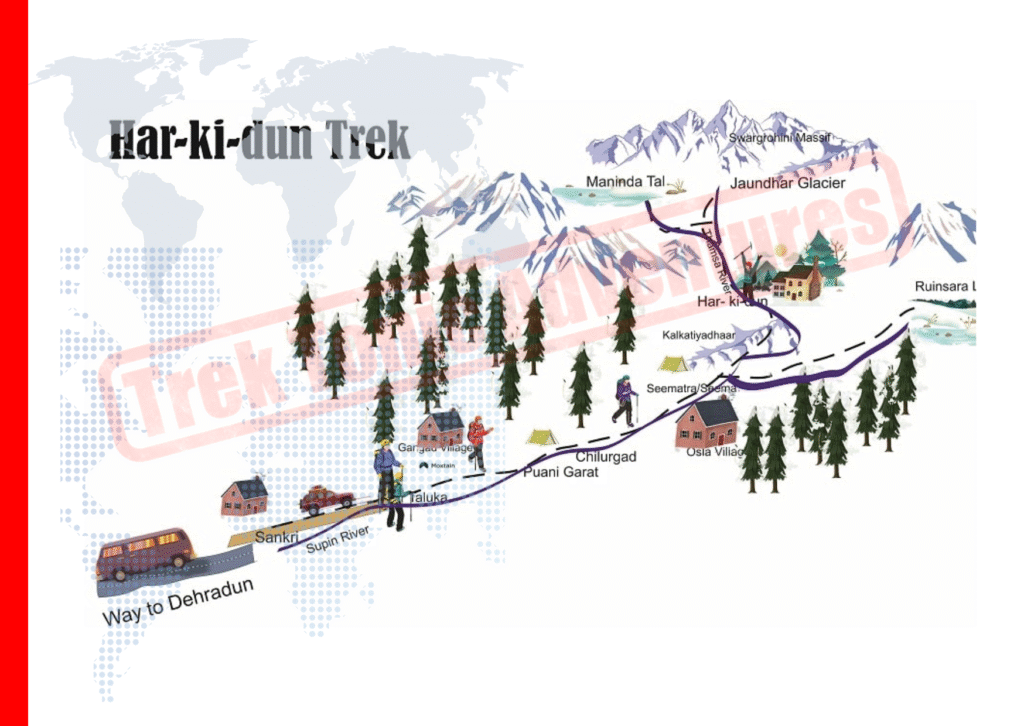
Har ki dun Trek Rout map
What Is Included & Excluded in the Har Ki Dun Trek Package?
What Is Included in the Har Ki Dun Trek Package?
The exact inclusions depend on the selected TrekTonic departure.
A standard package may include:
- Accommodation during the trek
- Camping equipment
- Trekking meals
- Trek leader / guide
- Local support staff
- Kitchen and camping equipment
- Required route or forest permissions, where applicable
- Basic first-aid support
- Sankri–roadhead transportation, if mentioned in the package
- Pre-trek coordination and briefing
What Is Not Included?
Unless specifically mentioned in your booking:
- Travel to Dehradun
- Personal trekking equipment
- Personal expenses
- Insurance
- Emergency evacuation expenses
- Backpack offloading / porter charges
- Extra hotel nights
- Meals outside the published itinerary
- Personal medication
- Any service not specifically mentioned under inclusions
What to Pack Har ki dun Trek
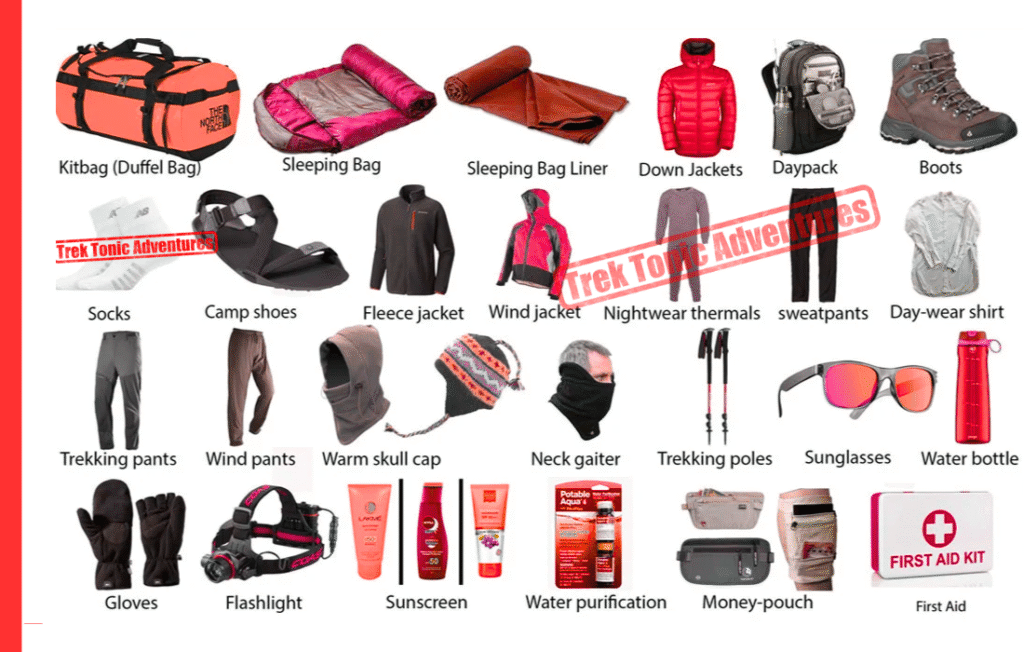
- Warm clothes (layers, thermals, jacket)
- Trekking shoes with good grip
- Raincoat/poncho
- Backpack with rain cover
- Water bottle, sunscreen, sunglasses
- Personal medicines and ID proof
How to Reach Har Ki Dun
Nearest City: Dehradun (well connected by road, rail, and air)
Base Village: Sankri (Uttarkashi district, Uttarakhand)
1. By Air 
- Nearest Airport: Jolly Grant Airport, Dehradun (approx. 220 km from Sankri).
- From the airport, take a taxi or bus to Dehradun city, then travel onward to Sankri.
2. By Train 
- Nearest Railway Station: Dehradun Railway Station.
- Well connected to Delhi, Haridwar, Rishikesh, and major cities.
- From Dehradun, hire a taxi or take a bus to Sankri.
3. By Road 
- Dehradun to Sankri distance: 200 km (8–9 hours by road).
- Route: Dehradun → Mussoorie → Purola → Mori → Sankri.
- Regular buses and shared taxis are available from Dehradun ISBT (morning departure recommended).
4. Trek Start Point 
- The trek begins from Taluka (12 km from Sankri).
- Drive Dehradun → Sankri → Taluka, then start trekking towards Seema/Osla
Fitness Preparation Har ki dun Trek
The Har Ki Dun Trek is a moderate Himalayan trek that involves long walking hours, uneven trails, uphill sections, and high-altitude conditions. Good stamina and basic strength can make the trek more comfortable and help you handle the physical demands of the route.
How to Prepare for the Trek
Start your fitness preparation at least 4–6 weeks before the trek. Focus on improving cardiovascular endurance, leg strength, and overall stamina.
- Walk or jog for 30–45 minutes, 4–5 days a week.
- Include stair climbing and uphill walking in your routine.
- Practice squats, lunges, calf raises, and basic core exercises.
- Gradually increase your walking distance rather than overtraining suddenly.
- Practice walking with a light backpack similar to what you will carry during the trek.
- Stay properly hydrated and follow a balanced, nutritious diet.
- Take adequate rest and sleep during your preparation period.
You don’t need advanced mountaineering experience for Har Ki Dun, but being physically prepared is important for managing long trekking days, elevation gain, and changing Himalayan trail conditions.
If you have an existing medical condition, previous altitude-related problems, or concerns about your fitness level, consult a qualified doctor before undertaking the
Food menu Har ki dun Trek
- Breakfast: Paratha/poha/upma with tea or coffee
- Lunch (packed): Roti-sabzi, boiled potato/egg, fruit
- Evening Snacks: Tea/coffee with biscuits, pakora, or noodles
- Dinner: Rice, roti, dal, vegetable curry, soup, dessert

Har Ki Dun Trek – Safety, Medical & Emergency Protocol
The Har Ki Dun Trek is a high-altitude Himalayan trek where weather, altitude, trail conditions, and accessibility can change quickly. Trektonic Adventures follows a practical safety and emergency protocol to help participants respond appropriately to altitude-related symptoms, injuries, sudden weather changes, and other unforeseen situations.
Safety equipment and emergency support are intended to reduce risk, but they cannot eliminate the inherent risks associated with high-altitude trekking.
Altitude Sickness: Symptoms & Immediate Response
Altitude-related illness can affect trekkers after gaining elevation, particularly when the body has not acclimatized properly.
Common symptoms may include:
- Headache
- Dizziness
- Nausea or vomiting
- Loss of appetite
- Unusual tiredness or weakness
- Shortness of breath during activity
- Disturbed sleep
- Difficulty concentrating
More serious symptoms such as breathing difficulty at rest, severe or worsening headache, confusion, inability to walk properly, persistent vomiting, unusual drowsiness, or loss of consciousness require immediate medical attention and may require descent or evacuation.
Immediate Response
If a participant develops concerning symptoms:
- The trek leader will assess the participant’s condition.
- The participant will be stopped from continuing the ascent if required.
- The participant will be given an appropriate rest period and monitored.
- The trek leader may recommend descent based on the severity of symptoms.
- In a serious or worsening situation, emergency medical assistance and evacuation will be arranged where practically possible.
Continuing to ascend despite worsening altitude-related symptoms is not permitted when the trek leader determines that it is unsafe.
Acclimatization & Rest Protocol
The Har Ki Dun Trek itinerary should allow participants reasonable opportunities to adapt to increasing altitude.
Our operational approach includes:
- Gradual altitude gain wherever the itinerary permits.
- Appropriate rest breaks during trekking hours.
- Regular hydration reminders.
- Monitoring participants for symptoms of altitude sickness.
- Additional rest or slower movement when required.
- Avoiding unnecessary rapid ascent when trail and operational conditions allow.
- Descent when a participant develops serious altitude-related symptoms.
The exact acclimatization schedule may be modified according to weather, trail conditions, group fitness, medical situations, government restrictions, or other operational requirements.
Trek Leader & First-Aid Support
The trek leader is responsible for coordinating the group and responding to emergencies within the limits of their training and available resources.
Trek Leader Training: [Insert confirmed certification/training level, e.g. First Aid / Wilderness First Aid / Basic Mountaineering / CPR certification]
The trek team carries basic first-aid supplies appropriate for common trekking injuries and minor medical situations.
First-aid support does not replace professional medical treatment. Serious injuries or medical conditions may require evacuation to an appropriate medical facility.
Nearest Medical Point & Evacuation Route
Because Har Ki Dun is located in a remote Himalayan region, access to medical facilities is limited compared with urban areas.
The operational evacuation plan may involve:
Trek Area → Nearest accessible roadhead → Local medical facility → Appropriate hospital/advanced medical facility
Nearest Medical Point: [Insert confirmed medical facility/location]
Nearest Roadhead: [Insert confirmed roadhead]
Primary Evacuation Route: [Insert confirmed route]
Emergency Hospital/Medical Facility: [Insert confirmed facility]
The actual evacuation route may change depending on the participant’s location, trail condition, road accessibility, weather, local administration instructions, and the nature of the emergency.
Emergency Evacuation Responsibility & Cost
If a participant requires evacuation, Trektonic Adventures will coordinate the available local support and transportation options as far as reasonably possible.
Depending on the situation, evacuation may involve:
- Local porter or support staff
- Trek team assistance
- Ground transportation
- Ambulance services where accessible
- Other locally available emergency transportation
Emergency evacuation is not automatically included in the trek package unless specifically stated in the booking terms.
Estimated evacuation cost:
[Insert confirmed estimated evacuation cost/range or state “Actual cost will depend on the situation, location, transport availability and service provider.”]
Unless otherwise specified in writing, emergency evacuation, medical treatment, hospitalization, ambulance, rescue, or other third-party emergency expenses are the participant’s responsibility.
Participants are strongly advised to have suitable travel and trekking insurance covering high-altitude trekking and emergency evacuation.
Weather Cancellation & Trail Closure Protocol
Mountain weather can change rapidly, and certain sections of the Har Ki Dun route may become unsafe because of snowfall, heavy rain, landslides, flooding, road blockages, trail damage, or other conditions.
If the trek route is considered unsafe, Trektonic Adventures may:
- Delay the departure.
- Modify the itinerary.
- Change the trekking route.
- Stop the group from proceeding to a particular section.
- Return the group to a safer location.
- Postpone the trek.
- Cancel the departure when necessary.
Decisions will be based on available weather information, ground conditions, local authorities, Forest Department instructions, trek staff assessment, and other relevant safety information.
Participants should not independently enter a closed or restricted trail.
Where cancellation or modification occurs due to weather, natural conditions, government restrictions, or other force majeure circumstances, refunds and alternative arrangements will be handled according to the applicable Har Ki Dun Trek Cancellation & Refund Policy.
Emergency Contact & 24-Hour Escalation
For emergencies during the trek, participants should immediately inform the trek leader or trek support team rather than attempting to manage a serious situation independently.
Trektonic Adventures Emergency Contact: +9181718 37222
24-Hour Emergency Escalation Contact: +9181718 37222
Operations/Support Contact: +9181718 37222
Participants should save these numbers before starting the trek because mobile network availability can be limited or unavailable on parts of the Har Ki Dun route.
In an immediate life-threatening situation, the participant/group should also contact the appropriate local emergency services whenever communication is available.
Travel & Trekking Insurance Recommendation
Trektonic Adventures strongly recommends that every participant obtain travel insurance before joining the Har Ki Dun Trek.
The policy should ideally cover:
- High-altitude trekking
- Emergency medical treatment
- Hospitalization
- Emergency evacuation
- Rescue assistance, where available
- Accidental injury
- Trip interruption or cancellation, where applicable
Minimum recommended coverage: [Insert confirmed insurance coverage amount]
Participants should check the insurance company’s terms carefully because some policies exclude trekking above specific altitude limits or exclude certain adventure activities.
Medical Conditions Requiring Doctor Consultation
Participants with existing medical conditions should consult a qualified doctor before undertaking a high-altitude trek.
Medical consultation is particularly important for people with a history of or current:
- Heart or cardiovascular conditions
- Lung or respiratory conditions
- Uncontrolled asthma
- High or low blood pressure
- Previous altitude-related illness
- Conditions affecting oxygenation or circulation
- Serious kidney or metabolic conditions
- Recent surgery or significant injury
- Any condition requiring regular medication or medical monitoring
Pregnant participants and people with significant medical conditions should obtain specific medical clearance before participating.
Participants must inform Trektonic Adventures about relevant medical conditions, allergies, medications, or previous altitude-related problems before departure where these could affect trekking safety.
A doctor’s clearance does not guarantee that a participant will be able to complete the trek. The trek leader may recommend stopping or descending if continuing becomes unsafe.
Oxygen Cylinder: Availability, Usage & Limitations
Oxygen support may be carried or arranged depending on the trek’s operational setup and current safety requirements.
Oxygen Availability on This Departure: [Confirm: Carried by trek team / Available at designated point / Subject to operational conditions]
An oxygen cylinder is an emergency support measure, not a safety guarantee or substitute for medical treatment.
If supplemental oxygen is required:
- The trek leader or trained trek staff will assess the situation.
- Oxygen may be administered when considered appropriate.
- The participant will be monitored for changes in symptoms.
- If the condition is serious or does not improve, descent and/or medical evacuation may be required.
Oxygen availability may be limited by cylinder capacity, terrain, duration of the emergency, transportation limitations, and the location of the participant.
Supplemental oxygen should not be used as a reason to continue ascending when a participant is showing serious altitude-related symptoms.
Participant Responsibilities
Every participant is expected to follow the safety instructions provided by the trek leader and support team.
Participants should:
- Follow the prescribed itinerary and instructions.
- Maintain adequate hydration.
- Inform the trek leader immediately about unusual symptoms.
- Avoid hiding or minimizing symptoms.
- Follow rest and descent instructions.
- Carry their prescribed personal medicines.
- Inform the team about relevant medical conditions and allergies.
- Avoid alcohol or other activities that may increase safety risks during the trek.
- Follow all trail, Forest Department, local authority, and environmental regulations.
The trek leader has the authority to modify, stop, or discontinue a participant’s trek when continuing is considered unsafe.
Important Safety Disclaimer
The Har Ki Dun Trek is an outdoor adventure activity in a remote and high-altitude Himalayan environment. Weather changes, altitude-related illness, injuries, trail conditions, road closures, natural disasters, and limited access to medical facilities are inherent risks of the trek.
Trektonic Adventures will take reasonable operational measures to support participant safety, but no trek operator can guarantee complete protection from illness, injury, evacuation, weather events, or other risks associated with high-altitude trekking.
For any serious medical condition or emergency, professional medical assistance should be sought as soon as reasonably possible.
Har Ki Dun Trek – Cancellation & Refund Policy
At Trektonic Adventures, we understand that travel plans can sometimes change due to personal, medical, weather, or other unforeseen circumstances. Our cancellation and refund policy for the Har Ki Dun Trek is designed to remain transparent and fair while covering the advance arrangements made for transportation, accommodation, permits, meals, trek logistics, local staff, and other operational services.
Please read the following terms carefully before confirming your Har Ki Dun Trek booking.
Cancellation Charges
Cancellation charges are calculated according to the number of days remaining before your scheduled Har Ki Dun Trek departure date.
| Cancellation Before Departure | Cancellation Charges | Refund Eligibility |
|---|---|---|
| 30 Days or More | ₹1,500 per person processing fee | Remaining amount refundable |
| 21–29 Days | 25% of total trek cost | Balance refundable |
| 15–20 Days | 50% of total trek cost | Balance refundable |
| 8–14 Days | 75% of total trek cost | Balance refundable |
| Within 7 Days | 100% of total trek cost | No refund |
| No Show / Trek Started | 100% retention | No refund |
The cancellation period is calculated from the date Trektonic Adventures receives the customer’s written cancellation request.
Booking Transfer Option
If you are unable to participate in the Har Ki Dun Trek, you may request to transfer your booking to another eligible person instead of cancelling it.
The following conditions apply:
- The transfer request must be submitted at least 7 days before the scheduled departure.
- The replacement participant must provide all required identification, medical, and other documents.
- The replacement participant must meet the applicable trek eligibility and fitness requirements.
- Any additional permit, transportation, accommodation, administrative, or operational charges will be payable by the customer.
- Booking transfers are subject to availability and approval by Trektonic Adventures.
- A booking transfer does not guarantee availability on another departure date.
Trek Credit – Future Booking Option
Instead of cancelling your Har Ki Dun Trek booking, you may request a Trek Credit Voucher, subject to approval by Trektonic Adventures.
The following conditions apply:
- The Trek Credit is valid for 12 months from the original departure date.
- It can be used toward an eligible future trek operated by Trektonic Adventures.
- The voucher is non-transferable unless specifically approved by the company.
- If the new trek costs more than the original booking, the price difference must be paid by the customer.
- If the new trek costs less, the remaining value will be subject to Trektonic Adventures’ applicable terms.
- Trek Credit availability is subject to departure and operational availability.
Cancellation, Postponement or Modification Due to Weather & Natural Conditions
The Har Ki Dun Trek takes place in a Himalayan region where weather and ground conditions can change rapidly. Participant safety is our highest priority.
The trek itinerary may be cancelled, postponed, modified, delayed, or rerouted due to circumstances including:
- Heavy snowfall
- Extreme weather conditions
- Landslides
- Floods or flash floods
- Road blockages
- Unsafe trail conditions
- Government restrictions
- Forest Department orders
- Local authority restrictions
- Natural disasters
- Any other force majeure circumstances beyond our reasonable control
In such situations, Trektonic Adventures will assess the conditions and arrange the best possible alternative, which may include an alternate itinerary, revised departure date, trek credit, or other suitable arrangement depending on availability and operational feasibility.
Please Note
Refunds cannot automatically be claimed for expenses that have already been incurred or committed, including:
- Transportation
- Accommodation
- Permits and entry fees
- Meals and campsite arrangements
- Trek staff and guide costs
- Local logistics
- Administrative expenses
- Other non-refundable operational costs
Where a refund is applicable, the refundable amount will be calculated after deducting actual non-refundable and operational expenses already incurred by Trektonic Adventures.
Alternate dates or Trek Credit may be offered where feasible and subject to availability.
Cancellation Due to Medical Emergency
If you are unable to participate in the Har Ki Dun Trek due to a genuine medical emergency before departure:
- Inform Trektonic Adventures as soon as possible.
- Submit valid medical documentation when requested.
- The request will be reviewed on a case-by-case basis.
- Trek Credit or partial adjustment may be considered at the discretion of Trektonic Adventures.
- Medical cancellations made close to the departure date may not qualify for a refund because operational arrangements may already have been confirmed.
- A medical emergency does not automatically guarantee a full refund.
Participants are also responsible for ensuring that they are physically fit and medically suitable for the Har Ki Dun Trek before joining.
During the Har Ki Dun Trek
Once the trek has started, the booking amount is generally non-refundable.
No refund will be provided if a participant:
- Voluntarily leaves the trek.
- Decides not to continue the trek.
- Is unable to continue due to insufficient fitness or preparation.
- Is advised to descend or discontinue the trek by the trek leader for safety reasons.
- Misses scheduled transportation or departure arrangements.
- Arrives late and misses the scheduled departure.
- Violates trek rules, safety instructions, or instructions given by the trek leader.
- Is unable to complete the trek due to personal reasons.
Unused services such as accommodation, meals, transportation, permits, camping arrangements, activities, or other trek services are non-refundable once the trek has commenced.
Refund Processing Time
Approved refunds are generally processed within 7–10 business days after the refund has been approved.
The refund will normally be credited to the original payment method or to the bank account details provided by the customer, where applicable.
Please note that:
- Payment gateway charges may be non-refundable.
- Bank charges and transaction fees, if applicable, may be deducted from the refundable amount.
- Actual operational and non-refundable expenses may be deducted before processing the refund.
Important Notes
- Cancellation requests must be submitted through email or WhatsApp using the registered contact details associated with the booking.
- The effective cancellation date will be the date on which Trektonic Adventures receives the written cancellation request.
- Refund calculations are based on the total Har Ki Dun Trek package cost.
- Promotional offers, discounted packages, group departures, corporate bookings, and customized Har Ki Dun Trek packages may have different cancellation terms.
- Any special cancellation conditions communicated at the time of booking will also apply where specifically agreed.
- Trektonic Adventures reserves the right to modify this cancellation and refund policy when operational, safety, legal, or business requirements change.
- Any revised policy will apply to future bookings unless otherwise communicated.
Need Help With Your Har Ki Dun Trek Booking?
If you need assistance with Har Ki Dun Trek cancellation, rescheduling, booking transfer, Trek Credit, or refund-related queries, please contact the Trektonic Adventures Support Team before your scheduled departure.
Our team will review your situation and help you with the best available option according to the applicable cancellation terms and operational conditions.