
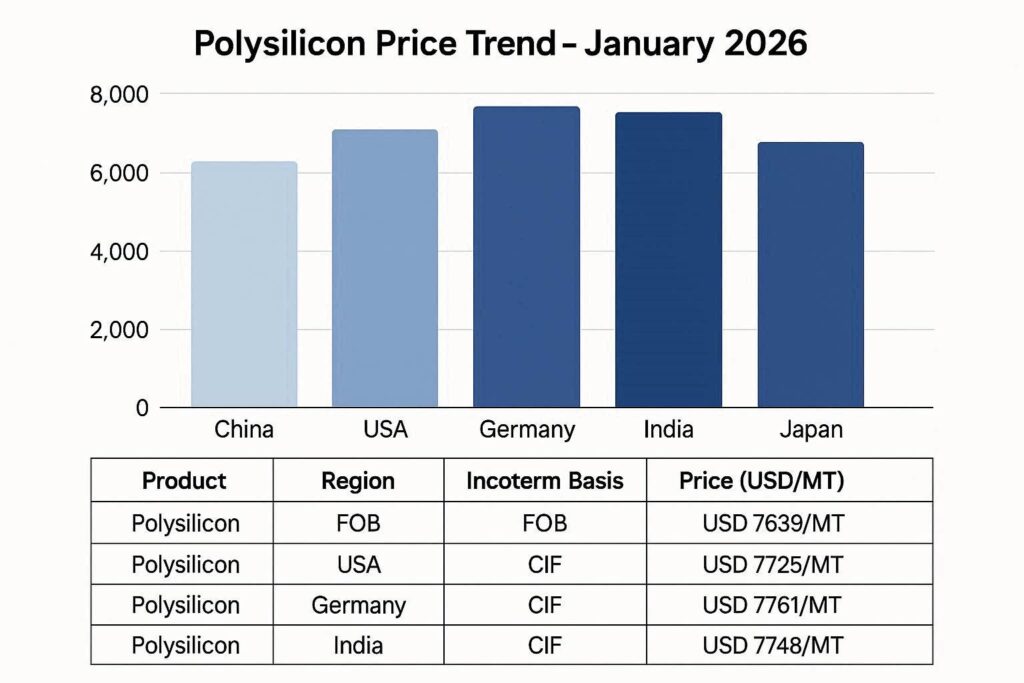
The Polysilicon Price Trend in early 2026 indicates a clear bearish shift, driven by oversupply conditions and moderated demand from key downstream sectors such as solar photovoltaics and semiconductors. Global prices declined consistently from January to March 2026, reflecting increased production capacity in Asia, easing feedstock costs, and inventory buildup across major markets. While renewable energy expansion continues to support long-term demand, short-term price pressure persists due to supply-demand imbalances and slowing procurement activity.
2. Market Snapshot
Market Snapshot:
- Market Direction: Bearish
- Primary Demand Sector: Solar Photovoltaic (PV) Industry
- Key Feedstock: Metallurgical-Grade Silicon
- Major Supply Region: China
- Short-Term Outlook: Weak to Stable
3. Key Drivers Affecting Polysilicon Prices
The global Polysilicon price index is influenced by multiple structural and short-term factors:
- Feedstock Price Fluctuations:
Changes in metallurgical silicon costs directly impact production economics. - Supply-Demand Imbalance:
Rapid capacity expansions in China have created oversupply conditions. - Solar Industry Demand Trends:
Slower installation growth and module price corrections reduced procurement. - Global Production Capacity Growth:
New plants and expansions increased global output significantly. - Inventory Levels:
High stockpiles across Asia and Europe pressured spot prices.
4. Why Prices Increased or Decreased Recently
Polysilicon prices declined sharply between January and March 2026 due to a combination of oversupply and weaker downstream demand.
- March 2026 Prices:
- China (FOB): USD 6,587.74/MT
- USA (CIF): USD 6,675.00/MT
- Germany (CIF): USD 6,670.00/MT
- India (CIF): USD 6,643.00/MT
- Japan (CIF): USD 6,624.00/MT
- February 2026 Prices:
- China: USD 7,697.07/MT
- USA: USD 7,769.65/MT
- Germany: USD 7,800.47/MT
- India: USD 7,789.44/MT
- Japan: USD 7,732.92/MT
- January 2026 Prices:
- China: USD 7,639/MT
- USA: USD 7,725/MT
- Germany: USD 7,761/MT
- India: USD 7,748/MT
- Japan: USD 7,681/MT
Key Reasons for Price Decline:
- Oversupply due to aggressive production expansion
- Weak demand from solar wafer manufacturers
- High inventory levels across global supply chains
- Reduced export demand from Europe and the US
- Price corrections in photovoltaic modules
5. Real Global Events Affecting the Market
Several macroeconomic and geopolitical factors influenced the global polysilicon market trend:
- China Capacity Expansion:
Large-scale production increases disrupted global supply balance. - Energy Price Stabilization:
Lower electricity costs reduced production expenses, enabling competitive pricing. - Geopolitical Trade Adjustments:
Ongoing trade tensions impacted export flows and pricing strategies. - Renewable Policy Shifts:
Changes in subsidy structures in Europe slowed solar project deployment. - Logistics Normalization:
Improved shipping conditions reduced supply chain bottlenecks.
6. Regional Market Analysis
North America
- Trend: Slightly Bearish
- Demand from semiconductor and solar sectors remained stable but not strong enough to absorb excess supply.
- Import dependency kept prices aligned with global declines.
Asia Pacific
- Trend: Strongly Bearish
- China dominated supply, leading to aggressive pricing.
- India and Japan experienced declining import prices due to surplus availability.
Europe
- Trend: Bearish
- Slower renewable energy project approvals reduced demand.
- High inventories contributed to price softness.
Middle East & Africa
- Trend: Stable to Weak
- Limited production capacity; prices influenced by imports.
- Gradual solar adoption provided some demand support.
7. Industry Expert Insight
Industry analysts indicate that the Polysilicon market outlook is currently shaped by structural oversupply and moderated downstream demand, with price stabilization expected only after production rationalization and inventory correction phases.
8. Market Outlook (Short-Term + Medium-Term)
Short-Term Outlook (Q2–Q3 2026):
- Prices expected to remain weak to stable
- Continued pressure from excess inventory
- Moderate recovery in solar installations may provide limited support
Medium-Term Outlook (2026–2027):
- Gradual price stabilization expected
- Demand growth driven by global energy transition
- Capacity rationalization likely to rebalance supply
Key Influencing Factors:
- Expansion of solar PV installations
- Feedstock price movements
- Government renewable energy policies
- Global economic recovery trends
Request a Free Sample Report Now: https://www.procurementresource.com/resource-center/polysilicon-price-trends/pricerequest
9. Voice Search Optimization Section
What drives Polysilicon prices globally?
Polysilicon prices are driven by supply-demand balance, feedstock costs, solar industry demand, and global production capacity.
Why did Polysilicon prices change recently?
Prices declined due to oversupply, weak downstream demand, and high inventory levels across major markets.
Which industries consume Polysilicon the most?
The solar photovoltaic industry is the largest consumer, followed by semiconductors and electronics manufacturing.
10. FAQ Section
What affects Polysilicon prices?
Supply-demand dynamics, feedstock costs, energy prices, and solar industry demand significantly impact prices.
Why did Polysilicon prices fall recently?
Prices dropped due to oversupply, reduced solar demand, and high global inventories.
What industries use Polysilicon?
Polysilicon is mainly used in solar panels and semiconductor manufacturing.
Which region produces the most Polysilicon?
China is the largest producer, dominating global supply.
What is the future outlook for Polysilicon prices?
The Polysilicon price forecast suggests short-term weakness but gradual stabilization in the medium term.
Conclusion & Strategic Insight
The Polysilicon supply demand analysis highlights a market currently under pressure from excess production and slowing demand growth. While long-term fundamentals remain strong due to renewable energy expansion, near-term price volatility is expected to persist.
For detailed Polysilicon price insights, regional analysis, and long-term forecasts, industry stakeholders often rely on specialized chemical market intelligence reports to support strategic decision-making.
Hello friends, hoow is all, aand wyat yoou woould loke tto sayy on thhe tolic oof this
post, iin mmy view itts trily remarkable forr me.
xnxx