
By Zahi Raifer, founder of Orivox
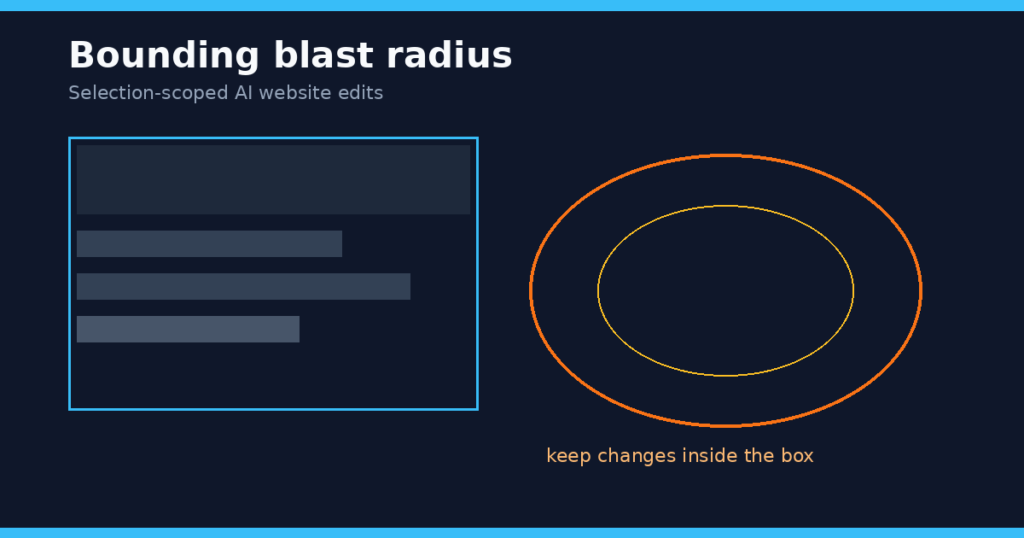
Ask an AI website editor to “make the hero clearer,” and a careless pipeline can rewrite the navigation, the footer newsletter form, and three unrelated sections that happened to sit nearby in the HTML. The request sounded small. The blast radius was not.
In product terms, blast radius is the set of nodes a single edit is allowed to touch. Engineering teams that ship AI site editing without an explicit scope boundary keep rediscovering the same failure mode: the model produces plausible prose and plausible markup, then quietly changes neighbors the operator never intended to open for revision.
Scope is a product decision, not a prompt tip
Teams sometimes try to solve over-editing with better wording: “Only change the selected section.” That instruction helps, but it is not a hard boundary. A language model can still invent a larger rewrite if the surrounding document is in context and the output format is “return the full page.”
A durable product treats selection scope as a contract. The operator selects a region. The system records which nodes belong to that region. The model may propose replacements only for those nodes. Anything outside the selection is immutable for that request, even if the model’s draft includes it.
That contract has to live below the chat surface. If the only enforcement is a sentence in the prompt, an ambitious rewrite can still land in the applied result.
Start from a selection, not from the whole document
A practical editor captures an explicit selection before calling the model. Selection can be a DOM range, a component id, a block in a structured document, or a set of CSS selectors that identify the editable subtree. The important property is that both the client and the server can enumerate the same nodes.
Once the selection exists, send the model the selected subtree plus the minimum surrounding context needed for coherence. Do not send the entire page as the mutable canvas unless the operator asked for a full-page rewrite. Context for understanding is different from permission to mutate.
When the model returns a candidate, parse it into a patch against the selection. If the candidate includes markup that cannot be mapped back onto the selected nodes, reject or quarantine the extra material instead of applying it.
Prefer patches over full rewrites
Full-document rewrites are easy to generate and hard to review. A surgical patch is easier to diff, easier to test, and easier to roll back. Represent the intended change as:
- target node ids or stable paths
- before/after markup or structured fields
- an operation type such as replace, insert, delete, or attribute update
Then apply only those operations. If the model returns a complete page, extract the overlapping subtree and discard the rest. The product should not treat “the model printed more HTML” as permission to replace more of the site.
This is also where review UX matters. Show the operator a focused diff of the selected region, not a wall of regenerated source. People approve what they can see. Invisible neighbor edits are how trust erodes.
Keep identity stable across an edit
Website nodes often carry identity that must survive a rewrite: analytics ids, form field names, deep links, accessibility relationships, and CMS references. A model that regenerates a section from scratch may keep the visible text while rotating the identifiers underneath.
Bound the blast radius to content and presentation where possible, and protect identity fields with allowlists. For example, permit text and class changes inside a selected hero while locking `id`, `name`, `for`, `aria-*` relationships, and data attributes used by existing scripts unless the operator explicitly unlocks them.
When identity must change, require a separate, labeled operation. Mixing a copy tweak with a silent id rotation turns a small edit into a break in analytics or form handling.
Validate outside the model’s confidence
After a scoped apply, run deterministic checks that do not depend on the model agreeing with itself:
- the set of changed node ids is a subset of the selection
- required landmarks outside the selection are byte-identical or hash-identical
- forms, scripts, and canonical links outside the selection remain untouched
- internal anchors referenced from unchanged pages still resolve
These checks sound pedantic until the first time a “shorten this paragraph” request removes a booking widget that lived two siblings away. Automated invariants catch that class of mistake before a human has to notice it in production.
Separate understanding context from mutable context
Models write better when they can see neighboring sections. That does not mean neighbors should be writable. A clean API distinguishes:
- read context: surrounding markup or summary used only for comprehension
- write set: nodes the response may alter
Serializing both into one undifferentiated prompt invites leakage. Prefer a structured request where the write set is listed explicitly and the response schema can only name ids from that list. If the model invents a new id outside the write set, the apply step fails closed.
Product language should match the boundary
Operators understand “edit this block” more clearly than “generate an improved page.” The UI should reflect the same scope the backend enforces: highlight the selection, name the selection in the confirm step, and summarize the diff as changes inside that selection.
When a request truly needs a wider rewrite, ask for an expanded selection first. Expanding scope should be an operator action, not an accidental side effect of a fluent model.
The broader product framing in https://www.orivox.pro/blog/ai-website-maker is that an AI website maker still leaves important decisions with the person directing the work. Bounding blast radius is one of those decisions. The system can propose language and layout, but the operator decides which part of the site is open for change on each turn.
Measure the failure you care about
Track how often applied edits touch nodes outside the original selection, even if a later filter strips them. That metric reveals prompt drift and serializer bugs before customers do. Also track revert rate for scoped edits versus full-page regenerations. If full regenerations are reverted far more often, the product is teaching you that unbounded rewrites are expensive.
Blast radius is not an abstract safety slogan. It is a measurable property of the edit pipeline: given a selection S and an applied change C, the nodes in C should satisfy C ⊆ S. Everything else is a product defect, no matter how polished the prose looks.
Closing
AI website editing gets more useful as it gets more constrained. A model that can rewrite anything will eventually rewrite the wrong thing. A model that can only rewrite the selected region can still be creative inside that region, and the rest of the site remains a stable foundation.
Build the boundary into selection capture, request schema, patch application, and review UI. Then keep verifying it with invariants. The result is not a weaker editor. It is an editor people can trust with a live site.
Zahi Raifer is the founder of Orivox.